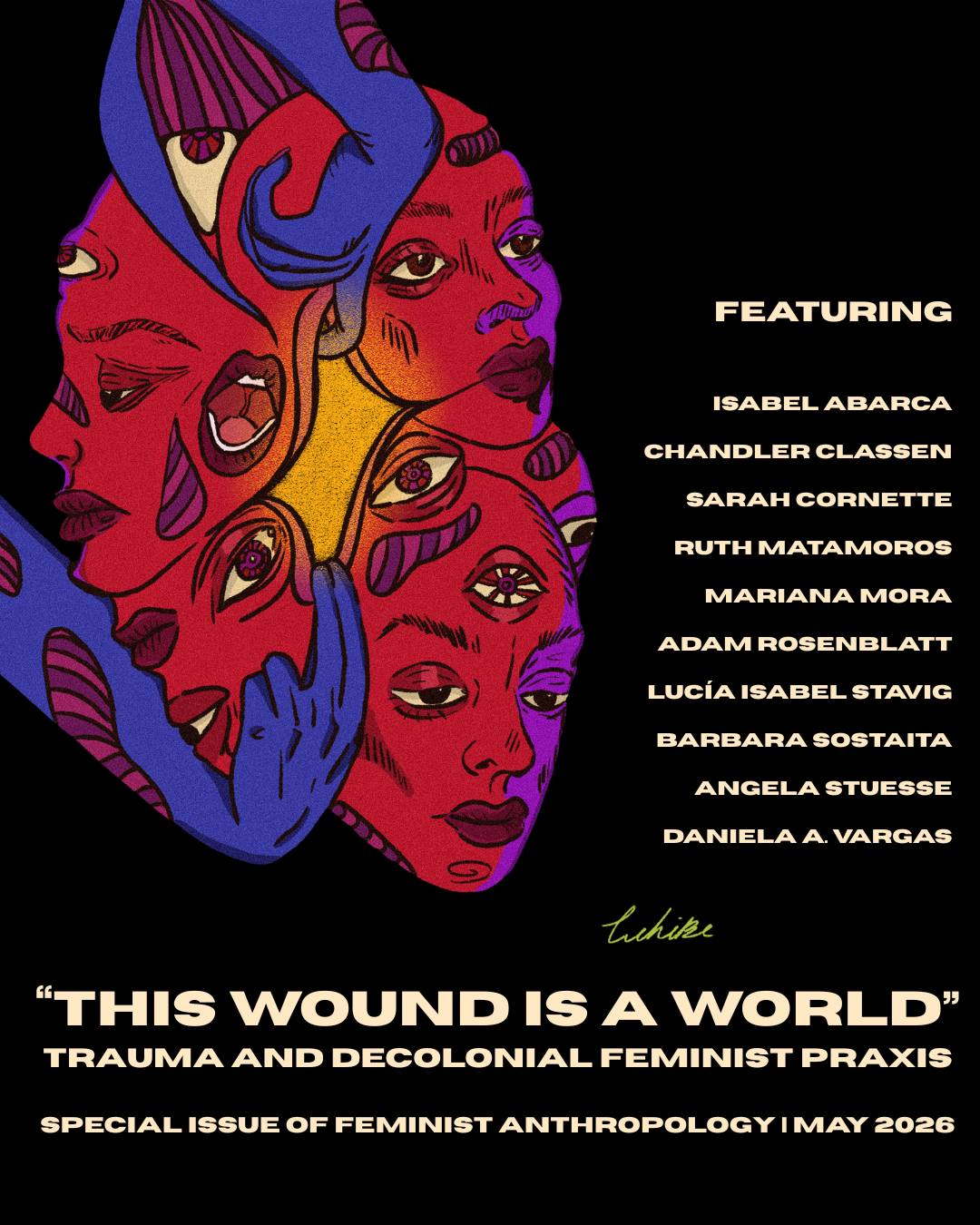
Art by @tichiketumalan
“The word ‘trauma’ etymologically derives from the Old Greek and means ‘wound.’ It is also related to the Proto-Indo-European trau, an extended form of the root tere, meaning to rub or to turn, to create friction or transform into something else. This special issue embraces these generative and complex dimensions of trauma and its afterlives. If, to borrow from Sarah Ahmed (2004, 202) a “good” wound is one that “sticks out, a lumpy sign on the skin,” and if we refuse to cover over or ignore its lingering scars, we ask, where does the wound lead us, and what worlds does it usher forth? After all, as the Chilean artist Cecilia Vicuña also suggests, trauma is a condition of creative possibility. After fleeing Pinochet’s regime in Chile, Vicuña learned his military dictatorship had ordered all leftist books to be burned or destroyed and had painted over public murals, including some of her own artwork. Years later, in a letter to a friend, Vicuña embraced this brokenness or incompleteness: ‘If we are to be made into litter and castoffs, then fine, I assume that position. I am garbage and a castoff, and that is my language—the exploded fragment’ (Vicuña in Schorske, 2022).”
- In “‘This Wound is a World:’ Trauma and Decolonial Feminist Praxis” by Barbara Sostaita and Angela Stuesse